- 24 November 2026
How Localisation Changes the Video Game Experience
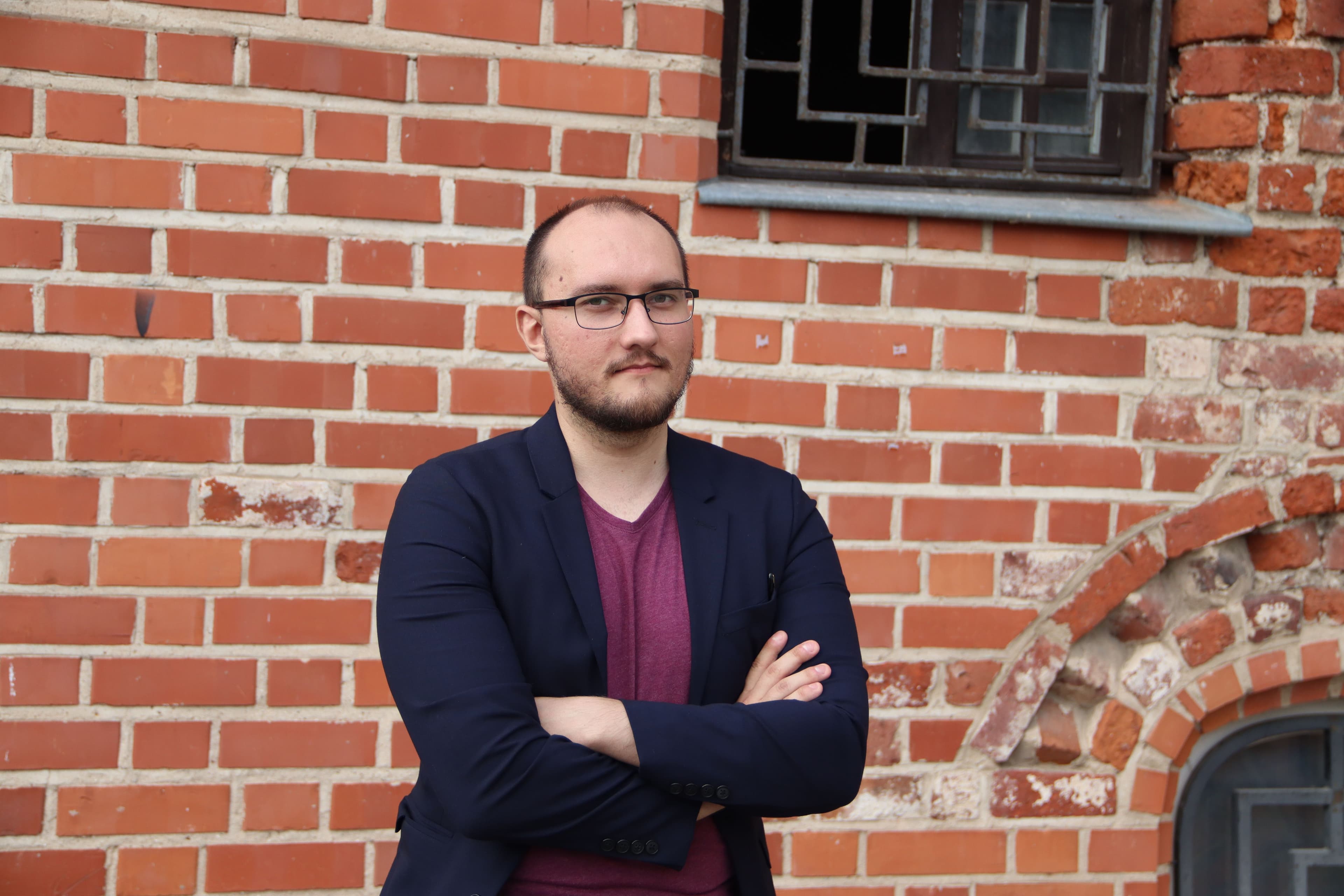
Video game localisation involves not only translating text from one language to another, but also cultural adaptation, adaptation of audio and visual elements, and shaping the player's experience. This topic is being explored in his research by Krzysztof Wiesław Hejduk, a doctoral student at the University of Łódź who is visiting the Kaunas Faculty of Vilnius University for the second time and teaches the Video Game Localisation course to students in the Audiovisual Translation program. The instructor is pleased with the students' ability to overcome technical challenges, and the community's warm welcome encouraged him to return to the faculty.
"At the Kaunas Faculty, every employee is valued as an individual, and this creates a welcoming and stable environment," says the lecturer.
From a bachelor's thesis to doctoral research
From a Bachelor's Thesis to Doctoral Research, K. W. Hejduk is involved in several linguistic research projects and has been honoured by the Polish Minister of Education and Science for his academic achievements.
Even while working on his bachelor's thesis, K. W. Hejduk knew he wanted to delve into the localisation of video games and analyse the unique aspects of translating this medium.
"Even as a child, I always strived to make sense of this weird, technology-mediated form of communication," explains the lecturer.
He initially developed his research during his master's studies and later continued it during his doctoral studies. K. W. Hejduk’s dissertation examines how translation decisions in video games affect the player's experience. The study combines several methods: participants play a localised game, their eye movements are tracked using special eye-tracking equipment, and after finishing the game, they answer questions and participate in interviews.
This line of research also gave the interviewee the opportunity to collaborate with the international community of game translation researchers. In 2024, together with his co-authors, he published the book Towards Game Translation User Research, a copy of which is available in the library of Vilnius University's Kaunas Faculty. The book User-Centric Studies in Game Translation and Accessibility, published in 2025, was edited by the lecturer in collaboration with Dr Mikołaj Deckert. The journal publishes articles by various researchers that examine user experience, game localisation, and accessibility.
Localisation — More Than Just an Accurate Translation
To properly adapt a game for players in another language and culture, it is important to understand its mechanics, technical solutions, and the impact of localised content on the player. K. W. Hejduk notes that students approach this field with ambition and a sense of responsibility.
"I've noticed that students are sometimes surprised themselves at how well they perform technical tasks," says the lecturer.
He emphasises that one of the most important goals of localisation is to ensure a positive user experience. Video games are a unique medium because they incorporate elements of film, theatre, and interactive software. The player not only observes events but also participates in them, and their actions can change the course of the game.
The lecturer explains that when localising a game, cultural differences, the user interface, audio, visuals, settings, and accessibility solutions are all taken into account. For example, a player can choose one language for the voiceover and another for the subtitles. Even more possibilities arise when adapting games for people with different sensory, motor, cognitive, or linguacultural needs.
"In a videogame, whichever element or gesture is generated on-screen, whichever sound or dialogue is rendered by the speakers, even entire segments of gameplay and software-behaviour mechanisms – can potentially be changed, to allow everyone a fair chance to have the sort of quality experience they want from a game," he explains accessibility options.
The lecturer argues that such a wide range of possibilities for customising games raises philosophical questions: "Who should be in charge of cranking the toggles up and down – the game creators, the company stakeholders, or the gamer themself? Are they even playing the same game if one person heavily modifies it while another does not? This naturally goes beyond game localisation."
Artificial Intelligence: Between Challenges and New Opportunities
As artificial intelligence and machine translation technologies advance rapidly, the translation profession and localisation processes are also changing. K. W. Hejduk emphasises that this field is evolving extremely quickly, so it is important to evaluate not only the potential of technological solutions but also their impact on people.
"My train of thought is that, as the landscape of translatorial professions starts to increasingly adopt the new machine translation solutions, an important variable defining the success of this switch should come from the humans in the loop – the vox populi and measurements of well-being among end-users and practitioners," he says.
These technologies are particularly relevant in video games, where players must navigate a constantly changing, interactive three-dimensional environment. The lecturer points out that artificial intelligence can help increase the accessibility of digital content: "Generative artificial intelligence makes it possible to convert visual information into audio, thereby providing a more accessible alternative for solutions that were previously limited or nonexistent. This is particularly important for blind and visually impaired players."